

Architecture + TECHNOLOGY: A Machine for Living In

Architectural styles, often based on classical Greek & Roman precedents and/or medieval precedents, cycled in and out of fashion for centuries.  Each revival introduced new variations in forms, materials, and ornamentation.  Throughout this time period, however, the overall compositions remained remarkably similar to the works which were the original sources of inspiration.  This continued into the late nineteenth and early twentieth century when, for some progressive architects, the connection to the forms of the past was combined with the connection to the technology of the present.

The industrial revolution in the West resulted in a proliferation of factories which became the inspiration for a new style of architecture: early modernism.  Factories and industrial buildings contained a rational structural grid allowing for long spans and flexible/open floor space.  Generally speaking, the facades were simple and sported little or no ornamentation. And of course the factories also contained machines, which provided further inspiration for some, as we will see.

New materials were introduced which allowed the willing architect an unprecedented  level of design freedom. Such materials included iron (and later steel), plate glass, stucco, and glass block. Greenhouses and buildings such as Joseph Paxton’s Crystal Palace, used large expanses of plate glass and thin iron fabrications.  These inovations allowed unprecedented quantities of light to flood the buildings. These buildings also used standardized and mass produced components, allowing for faster building erection and deconstruction and resulting in lower costs for both labor and materials.
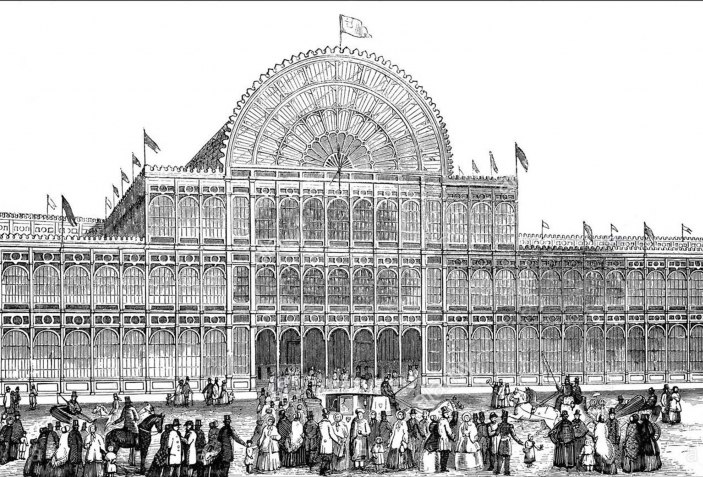
the Crystal Palace by Joseph Paxton

Architects such as Alfred Loos, Peter Behrens and Otto Wagner pioneered this new style.  But it was the Swiss born architect LeCorbusier, who refined and codified it.  He refined it through the design and construction of a series of villas in the 1920s.  These villas demonstrated machine-like precision.  He codified it through the publication of his Five Points of Architecture.  These five points are well illustrated in the Villa Sayoye, which was completed in 1931 in Poissy France.  They are: columns which raise the building above the ground, a flexible and open plan, a functional roof garden, ribbon windows, and curtain walls.
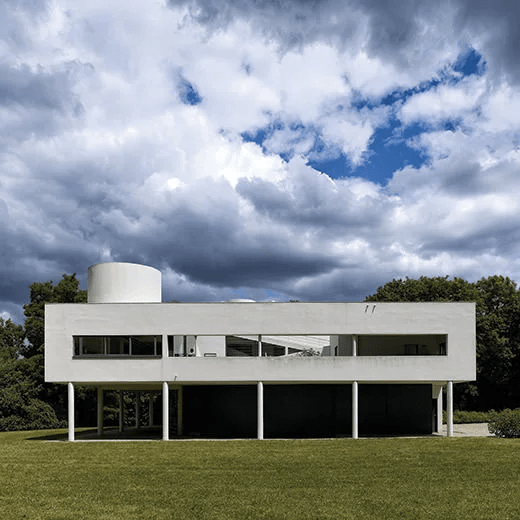
Villa Savoye by LeCorbusier

The roof garden is separated from the interior by a large expanse of plate glass. The columns support the floor, meaning that the exterior walls are not load bearing and may act simply as “curtains”.  Curved forms and ramps reflect movement and contrast with the orthogonal rigor of the structural grid.

“Rooftop Garden” of the Villa Savoye

Our first impression is that the building is not only devoid of ornamentation but also devoid of historical precedence.  Such is not the case.  In 1911 LeCorbusier traveled throughout central Europe and spent three weeks studying and sketching the Acropolis.  He subsequently wrote: “The Greeks built temples on the Acropolis which answer to a single conception, and which have gathered up around them the desolate landscape and subjected it to the composition.  So from all sides of the horizon the conception is unique.  That is why no other works of architecture exist which have this grandeur.” In the Villa Savoye we can see LeCorbusier working with a simple geometric form which dominates the landscape, and which is unique from every vantage point. Finally, he is seeking grandeur in the form of what he called a “machine a habiter,” a machine for living in.
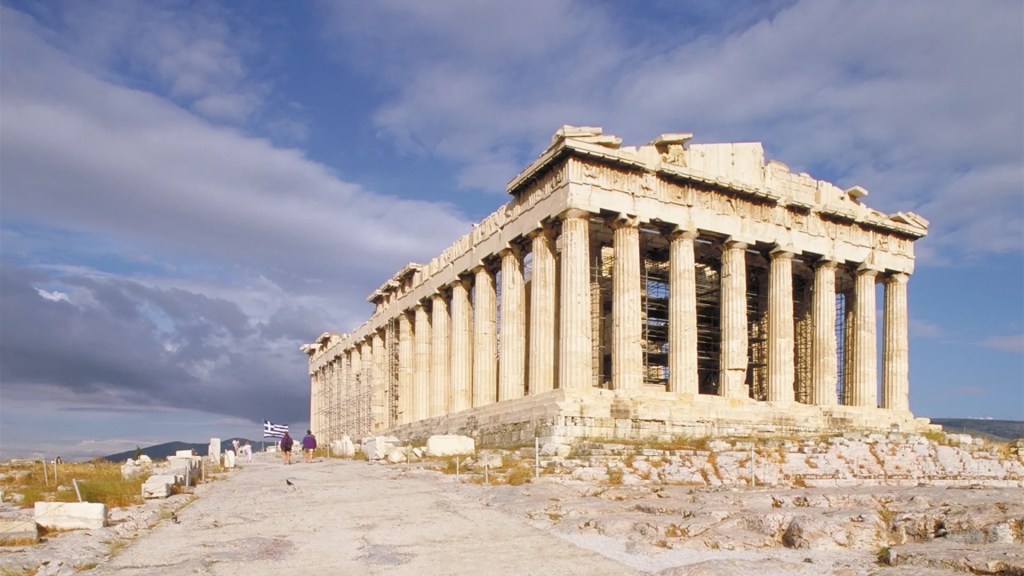
the Parthenon – jewel of the Acropolis

This new “looser” way of connecting to the architecture of the past conditioned throughout the 20th century, including an Athens Greece to Athens Alabama connection! You can find out about that in My Big Fat Greek Architecture. Thanks for checking out this blog post and stay tuned for another ArchitectureConnection soon!
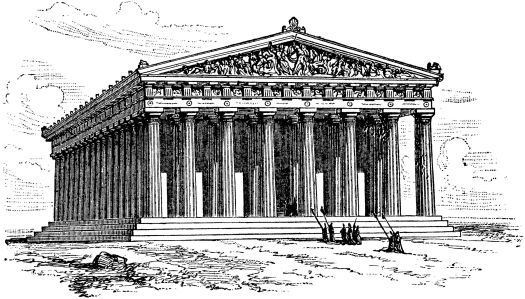
Architecture + HISTORY: My Big Fat Greek Architecture

The earliest structures built by mankind were simple shelters designed primarily to keep the elements out. The builders were hunter-gatherers and their structures were temporary and transient. They were not what we would consider “Architecture” (with a capital A).  As mankind progressed to higher degrees of civilization, and as the division of labor came about, he began to think of built structures as more than simple shelters.  These structures began to reflect elements of art – a required component in “Architecture”.  But when exactly did this transformation take place? I’m not sure we can tie it to a precise time, although I think we can identify a time period.  I am reminded of a scene in the movie My Big Fat Greek Wedding in which the father of the bride is able to trace any word back to the Greek root.  In much the same way, I contend that all “Architecture” (at least in the West) can connect back to Greek roots.

clip from My Big Fat Greek Wedding

The Classical Greek period lasted from the 5th to the 4th centuries BCE.  Classical Greek buildings such as the Parthenon in Athens, completed in 438 BCE, later inspired the architect-builders of the Roman Empire. The Romans adopted and adapted the architecture of the Greeks.  Over the centuries, the style periodically fell out of favor, but it has been consistently resurrected in a slightly modified forms, in revival styles.  

The Parthenon – Athens, Greece

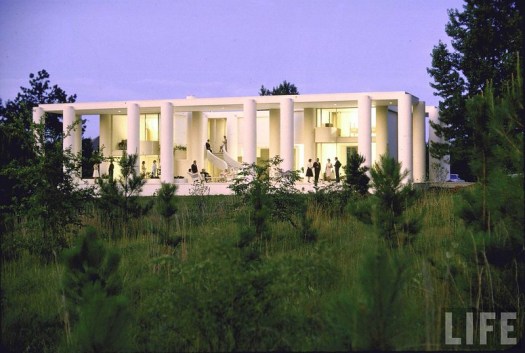
Architecture can be connected to these Greek buildings without being stylistically similar.  The forms, massing, scale, and rhythm derived from these works can be devices used by the creative architect, whether or not the architect is practicing in the “classical style”. A fine example of this may be found in another Athens – Athens, Alabama.  Paul Rudolph, perhaps the most prominent architect of his day, designed a home for Mr. and Mrs. John W. Wallace. The house was featured in many journals, including a 1964 Life magazine article.  Following are Rudolph’s own remarks regarding the house:

“Years ago I designed a house in Alabama based on Greek revival architecture of the South. I was brought up in that area, I knew it well, and my first memories of architecture were the Greek Revival buildings of the area and the sharecroppers’ cottages, both of which intrigued me no end. Both seemed to have a complete validity – in other words, vernacular and so-called high architecture. This house in Alabama has double-story-high porches on four sides, over-scaled columns not based on structural need but on character – yet it’s a modern house. It doesn’t ever deal with Greek columns, capitals and bases, cornices, nor the use of symbols, but the image of the south is very clear. The design comes from the climate, the environment, how people live, what was suitable. It gets very hot in summer; therefore, the enclosure is put in man-made shade, which lowers the energy consumption of the air-conditioning system. It has many symmetrical parts, but the circulation and spatial organization is asymmetrical. If you know the location of this house it is clear that it really comes from the Greek Revival architecture of the South, but it certainly doesn’t have any Greek Revival symbols, although its image is similar because it tries to solve some of the same problems.”
Davern, Jeanne M. “A Conversation with Paul Rudolph.” Architectural Record 170 (March 1982): 90-97.

Wallace Residence designed by Paul Rudolph

I contend that much can be learned from the architecture of the past. It can inspire and inform, as classical architecture inspired and informed Paul Rudolph in his design of the Wallace Residence.  I do, however, question the practice of some to literally duplicate large portions of prior works. In my view, neither the copied work nor the derived work benefit.  If architecture (or any other form of art) is not of its time, it becomes overused and stagnant.

Next time we’ll explore the roots of modernism and see how architecture connects to technology in ….. A Machine for Living In. Spoiler alert: Remember that all “Architecture” (at least in the West) can connect back to Greek roots.